15-19 William Street South, BT1 4AR
About Ross's Court
Ross’s Court is situated at 15-19 William Street South in Belfast, Northern Ireland. This site is an integral part of Belfast's architectural and historical landscape, bordered by William Street South and Montgomery Street. The complex, including 1-7 Montgomery Street, is recognized for its distinct architectural design and longstanding connection to Belfast's industrial and commercial heritage.
Ross’s Court holds a B2 listing (HB26/50/177) as of November 1988, underscoring its value within Northern Ireland's built heritage. The surrounding area comprises a mix of historic buildings, modern commercial establishments, and retail outlets, contributing to Belfast's evolving urban environment.
Throughout its history, Ross's Court has accommodated various commercial enterprises. The most recent tenant was Argos, which commenced operations at the site in 1998. However, the store closed in March 2020, leaving the property vacant. Since then, it has been listed for redevelopment. In February 2022, CBRE marketed the property with offers invited in excess of £5.75 million. The Martin Property Group acquired the site from Aberdeen Asset Management in June 2022.
The history of Ross’s Court dates back to the late 19th century. The buildings at 15-19 William Street South and 1-7 Montgomery Street were developed between 1883 and 1909 for William A. Ross & Co. Ltd, a prominent manufacturer of mineral water.
William Adolphus Ross (1817-1900) acquired the site in 1879 after serving as managing director at Cantrell & Cochrane, another leading soft drinks company. Establishing William A. Ross & Co. Ltd, he rapidly expanded production. By November 1879, the company was manufacturing approximately 30,000 bottles of mineral water daily, exporting to markets across the United States, West Indies, and Africa.
Ross’s Royal Ginger Ale became the company's signature product, operating under the trade name ‘The Royal Belfast Ginger Ale, Mineral & Aerated Water, and Cordial Manufactory.’ The company also produced a range of beverages, including soda water, lemonade, potash water, seltzer, sarsaparilla, Lithia, Vichy water, aromatic bitters, and cola. The site was strategically developed with deep wells extending up to 420 feet to support production needs.
1883: Architect Robert Graeme Watt designed a warehouse at 1-7 Montgomery Street, incorporating a distinctive Tudoresque Dutch gable and an oriel window at the intersection of William Street South and Montgomery Street.
1902: Watt, now part of the firm Watt & Tulloch, designed a three-storey warehouse addition on William Street South, constructed by McLaughlin & Harvey.
1909: Watt & Tulloch designed an office extension at the rear, built by Robert Corry at a contract value of £23,015.
By 1914, William A. Ross & Co. Ltd had expanded its exports to the United States, Argentina, Brazil, and Chile. However, trade declined during wartime. The company recovered post-war and continued operations at the site until 1975, when production moved to Ravenhill Avenue. In 1986, the firm merged with Cantrell & Cochrane (C&C Group).
Following the relocation of operations, the site was repurposed into a retail centre known as Central Arcade in the late 1970s, housing multiple retailers such as Crazy Prices and Stewarts Winebarrel.
In the late 1980s, Ewart PLC acquired the complex and initiated redevelopment plans. Between 1990 and 1991, the site was transformed into Ross’s Court, a three-storey shopping centre designed by Ostick & Williams and Ferguson & Wheeler at a cost of £5 million. The centre initially housed 44 tenants, featuring a top-floor food court with decorative brass and wood elements.
By 1997, Ewart PLC gained full ownership of the property and announced in 1998 that the entire site would be leased to Argos. Following a £1 million refurbishment, Argos launched its 55,000-square-foot store in October 1998 under a 25-year lease, initially set at £350,000 per annum, rising to £400,000 per annum in the fifth year.
Ewart PLC sold the property in May 2001 for £6.3 million, following an initial valuation of £1.9 million before refurbishment and the Argos lease agreement. Argos remained operational at the location for nearly two decades before ceasing operations in March 2020.
In August 2024, South William Street Properties Limited submitted a planning application (LA04/2024/1362/F) and listing building consent (LA04/2024/1363/LBC) proposing plans for subdividing the existing retail unit (Class A1) into two separate commercial spaces. Key elements of the proposal include:
Dividing the retail space to accommodate two distinct tenants.
Restoring and repairing ground-floor windows and doors to preserve the building's historic character.
Reconfiguring the shopfront entrance on William Street South to provide separate access points for the two proposed units.
These applications were approved in October 2024.
In November 2024, it was revealed that Russell & Bromley, a luxury UK footwear and handbag retailer, and Mango, a Spanish fashion chain, are moving into the subdivided units. Russell & Bromley are expected to open in March 2025.
Project Information
Project Team
Loading
Havelock House
Updated 2 years ago
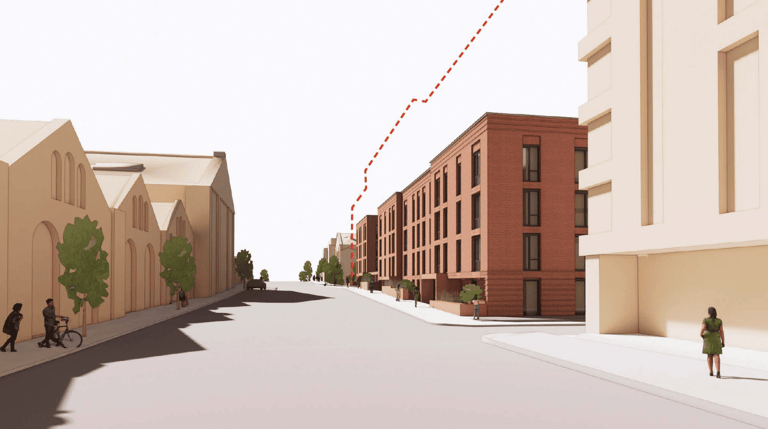
Havelock House is a proposed residential apartment development on the site of former headquarters of UTV Media. Havelock House is situated along the Ormeau Road and was the home of UTV from 1959 until 2018, when the broadcaster relocated to City Quays.
16 May Street
Updated 2 years ago
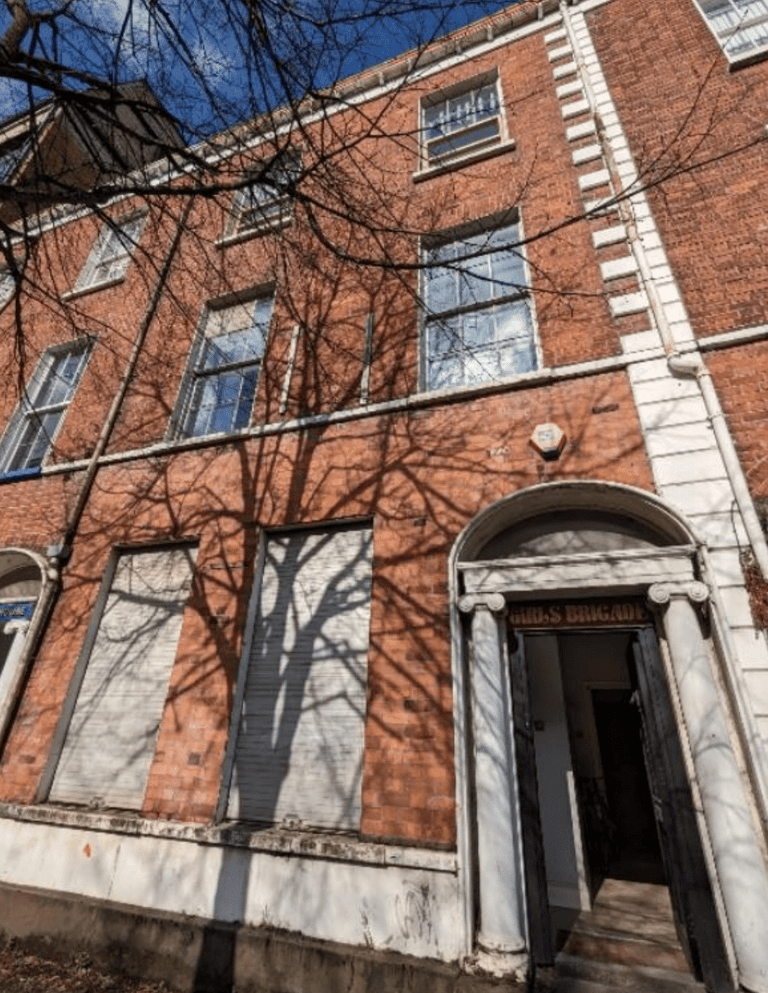
16 May Street is a B2 listed, three-storey townhouse made of red brick, dating back to approximately 1855. It first appeared on the second edition of the Ordnance Survey maps for Belfast in 1858.
Cathedral Gardens
Updated 7 months ago
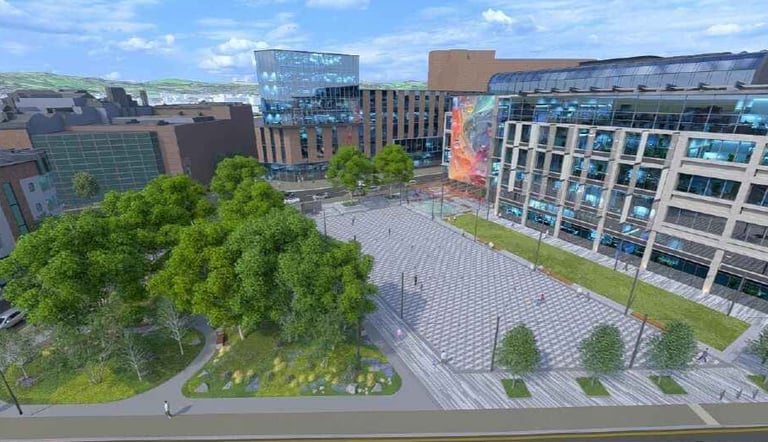
Located in the heart of Belfast, adjacent to St Anne’s Cathedral and Ulster University, Cathedral Gardens—also known as Buoys Park—occupies a prominent 0.55 hectare spot between York Street and Academy Street.
