2-10 Bridge Street, BT1 1LU
About Northern Whig House
Northern Whig House is a three storey Grade B1 listed building (HB26/50/060) located at the prominent junction of Bridge Street and Waring Street in Belfast city centre.
Northern Whig House, formerly called the Commercial Buildings, was originally constructed between 1819 and 1820, based on a design by the Belfast architect John McCutcheon. It was built to replace a row of cottages, and on completion, opened on 1 November 1820. The building initially functioned as a hotel, newsroom, assembly rooms and offices for the Northern Whig Club - a liberal political and literary society that played a significant role in Belfast’s civic life during the early 19th century.
In 1919, the premises were acquired by The Northern Whig newspaper, which redeveloped the site to accommodate its editorial and printing offices. During this time, the Bridge Street elevation was rebuilt in red brick, reflecting early 20th-century construction practices. However, the building suffered substantial damage during the Belfast Blitz of 1941. A restoration process was undertaken, culminating in 1959, which reinstated much of the building’s appearance and functionality, albeit with some modern interventions.
The newspaper ceased operations in 1963, after which the building was used primarily for office accommodation. Northern Whig House was officially listed in 1975, recognising its architectural and historical significance.
In 1997, Clanmil Housing Association acquired the building. The upper floors were refurbished for office use, while the ground floor was transformed into a bar and restaurant. The venue reopened as “The Northern Whig,” a name that pays homage to both the original tenants and the building’s journalistic legacy.
At present, Northern Whig House remains in mixed commercial use. The ground floor operates as a licensed bar and restaurant under the name “The Northern Whig,” known for its distinctive interior featuring Soviet-era sculptures and a blend of classical and modern design elements. The upper floors are retained for commercial office space.
In May 2025, The Horatio Group submitted two planning applications relating to Northern Whig House:
Planning Application LA04/2025/0777/LBC (Listed Building Consent):
This application seeks consent for alterations to the existing building to enhance the internal configuration and external appearance. The proposals include:
The relocation of the existing cold store at the rear of the property to facilitate the creation of a new snug bar within the ground floor bar premises.
Partial demolition to the east elevation of the building, including the formation of a new entrance and window, along with associated signage.
The proposed interventions are intended to improve internal circulation, enhance customer experience, and provide a new intimate area within the bar while maintaining the architectural integrity of the listed building.
Planning Application LA04/2025/0775/A (Advertisement Consent):
This application proposes the installation of:
One traditional timber fascia sign, to be externally illuminated by heritage-style lanterns.
One projecting sign, consistent with the existing architectural language of the building and the conservation area context.
The signage aims to be visually sympathetic to the character of the building and surrounding conservation area while providing clear and appropriate branding for the premises.
As part of the current proposals, a new snug bar will be established within the premises under the name Peggy Barclay’s Tavern. This is a historically significant name, drawn from an 18th-century tavern that once operated in nearby Sugarhouse Entry.
The original Peggy Barclay’s Tavern, also known as the Dr Franklin Tavern, was a key meeting place for the Society of United Irishmen during the 1790s. The venue played a central role in Belfast’s radical political movement and is closely associated with historical figures such as Henry Joy McCracken. It also served as a social and planning venue for the group, operating semi-clandestinely under the alias “The Muddler’s Club.”
The tavern was ultimately destroyed during the Belfast Blitz of 1941, and no physical trace remains today. However, its legacy endures in Belfast’s cultural memory and local lore.
Project Information
Floors
3
Planning References
LA04/2025/0777/LBCLA04/2025/0777/LBC
Loading
Choice Housing Association
Updated a year ago
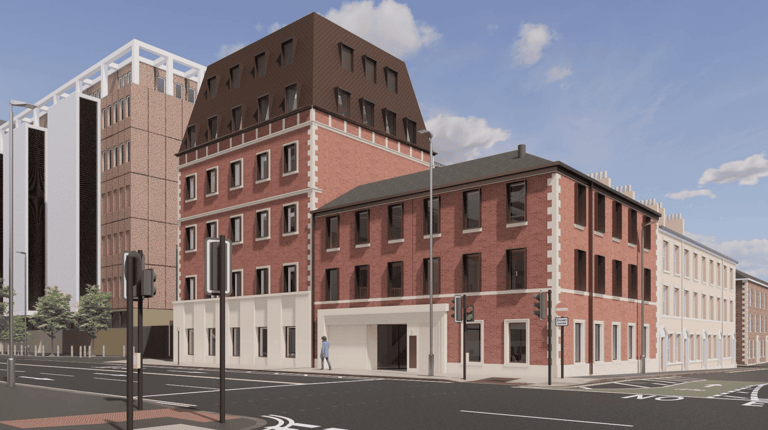
31-35 and 37-41 May Street is a site forming part of the headquarters for Choice Housing Ireland, a major housing association operating across Northern Ireland and the Republic of Ireland. The buildings include:
Park House Healthworks
Updated 2 years ago
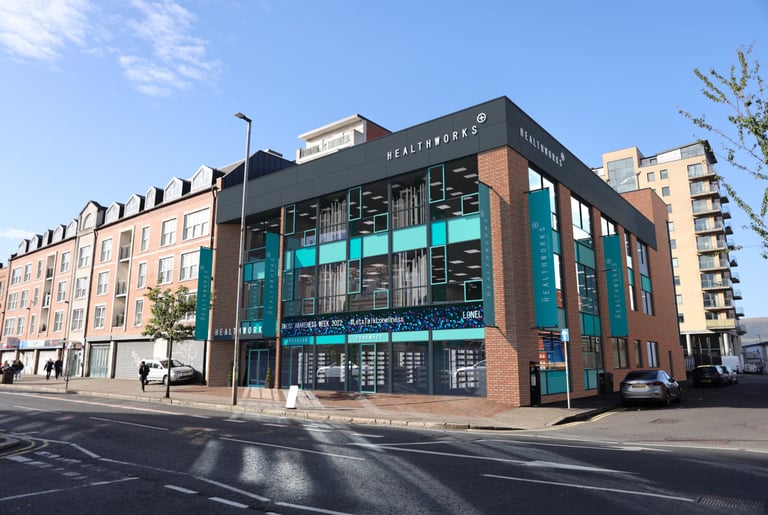
Park House is a 3-storey office building fronting onto Great Victoria Street and extends to 4 storeys towards the rear of the building. The existing site has a footprint of approximately 733sqm and comprises a total Gross External Floorspace of 3085 sqm.
St Comgalls
Updated 2 years ago
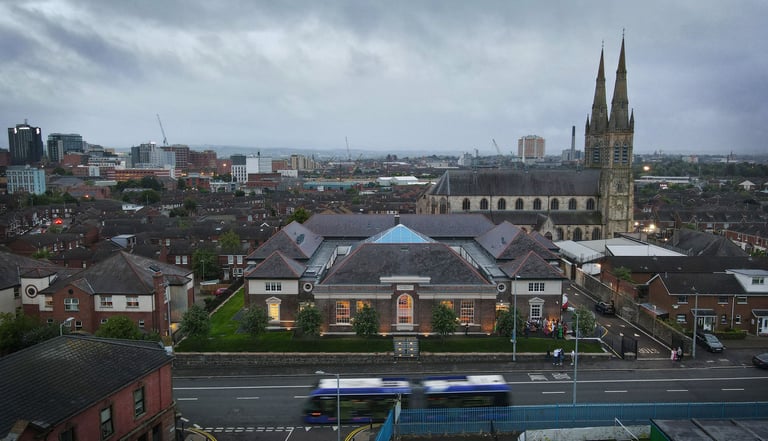
St Comgalls is a two storey Listed Grade B1 (ref. HB/26/33/004) building that is located on Divis Street. The site was occupied by the old Belfast Model School from 1855 until it was destroyed by fire in 1922. The Catholic Church subsequently took over the site in 1932 and it became St Comgall's Primary School (originally known as St Comgall's Public Elementary School), which opened in December 1933. St Comgalls was designed by R.S. Wilshere. The buildings are characterised by their Neo-Georgian facades in red clay brickwork and grey 'cast stone' with large multi-paned windows and pitched slated roofs. St Comgalls Primary School closed in the 1999. For a period of time after the closure of the school, the Training and Employment Agency and WorkNet had offices in the building to help people into employment. The offices closed down and eventually the site became derelict.
