Royal Avenue, BT1 1EA
About Belfast Central Library
Belfast Central Library, located on Royal Avenue, is a prominent three-story red sandstone building designed by architect William Henry Lynn for the Belfast Corporation. Constructed by H & J Martin, the library features an internal iron staircase crafted by Brawn of Birmingham. The building was officially opened in 1888 as Belfast's first free public library and has since served as a vital educational and cultural resource for the city.
Situated in the heart of Belfast, the library occupies a significant position within the city's urban landscape. It is part of the Library and Cathedral Quarter, adjacent to Belfast City Centre and near the Belfast Campus of the University of Ulster. The library continues to function as a public library, offering a range of services including lending, reference materials, IT facilities, and hosting various community events. Despite its historical significance, the building faces challenges related to aging infrastructure and the need for modernisation to meet contemporary standards.
Belfast Central Library was constructed between 1884 and 1888 to designs by architect William Henry Lynn, following the 1882 adoption of the Public Libraries Acts by Belfast Town Council. Despite widespread resistance to free libraries across Ireland, Belfast supported the initiative without outside funding, marking a progressive civic move. The opening day of the library on 13th October 1888 coincided with Belfast being granted city status, symbolizing a new era in its urban development.
The building was constructed using Ballachulish granite (the first shipment of which was lost at sea) and red Dumfries sandstone, with fine architectural features referencing Belfast’s linen industry. Its design included a reading room, lending library, reference library, art gallery, and even artists’ workrooms.
The library boasted modern innovations like a hydraulic lift, hot water heating, and Cotgreave’s patent indicator system for book borrowing. Early benefactors donated thousands of volumes and works of art by masters like Caravaggio and Van Eyck, turning it into a cultural and educational hub. Notably, G.H. Elliott was controversially appointed as librarian from outside Ulster.
Originally housing an art gallery and museum (including Rev. Canon Grainger’s collection), these were later transferred to a new facility on Stranmillis Road in 1929. The library suffered bomb damage during the Belfast Blitz and again in 1976, and was unfortunately sandblasted in the 1970s, which caused the loss of some carved details.
A major restoration took place between 2009 and 2011, led by architects Knox and Markwell, using original materials and sensitive techniques.
Plans for a comprehensive redevelopment of Belfast Central Library have been under consideration for several years. In 2013, the Culture, Arts and Leisure Committee proposed creating a regional library as part of the 'Library Square' project. Todd Architects were engaged to design a scheme that includes restoring the original building and adding a modern extension, connected by a three-story glazed entrance hall opening onto a new public realm. The proposed project aims to provide approximately 9,000 square meters of public library space. However, as of 2016, Libraries NI had yet to secure the necessary approvals and funding to advance the project. The redevelopment is estimated to cost up to £40 million, with the most recent business case submitted in November 2015 proposing a £32.5 million investment.
In the interim, the Belfast Inner North West Action Plan has identified the library as a key site for reactivation, proposing initiatives such as illuminating ground-floor windows and highlighting architectural features to enhance its presence within the cityscape. The plan also envisions the library playing a role in creating flexible work, innovation, and cultural spaces, contributing to the broader regeneration of the area.
As of April 2025, the redevelopment plans for Belfast Central Library remain uncertain due to ongoing resource pressures. Libraries NI continues to prioritise the project strategically; however, financial constraints have hindered significant progress. In a recent statement, the Department for Communities acknowledged these challenges and indicated that efforts are underway to address the issues.
Despite these setbacks, the architectural vision for the library's redevelopment, as designed by Todd Architects, remains in place. The proposed design includes a modern extension seamlessly integrated with the original red sandstone building through a three-story glazed entrance hall, aiming to enhance accessibility and provide contemporary facilities for the community.
Project Information
Cost
£40,000,000.00
Floors
3
Project Team
Loading
Smithfield Yard
Updated 4 years ago
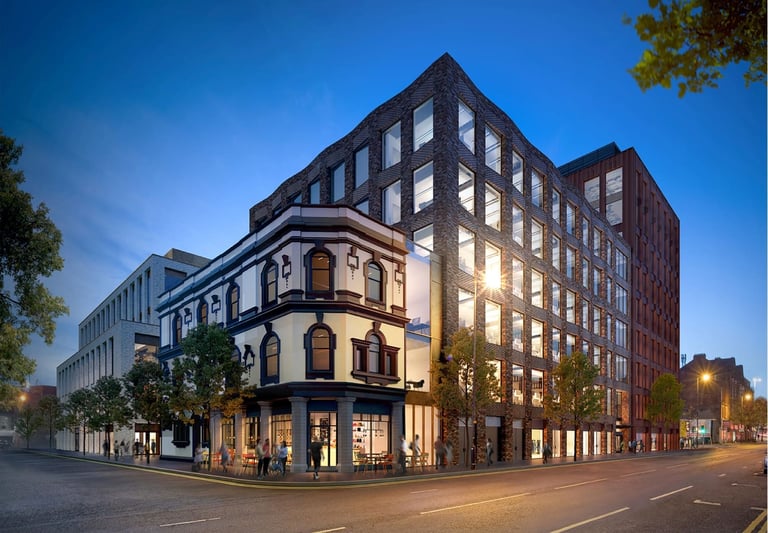
Simthfield Yard is currently occupied by a surface level car park and the listed Butcher's Building and is bounded by Winetavern Street, Gresham Street and North Street. Historically, the site had an continuous frontage and the centre of the site operated as a bus station. The introduction of CasteCourt in the 1980s resulted in the majority of the street pattern being blocked off. This part of the city centre has suffered from significant blight and under-investment since then. This resulted in many of the buildings being demolished and occupied by a surface level car park since the 1980s.
12 College Square North
Updated 2 years ago
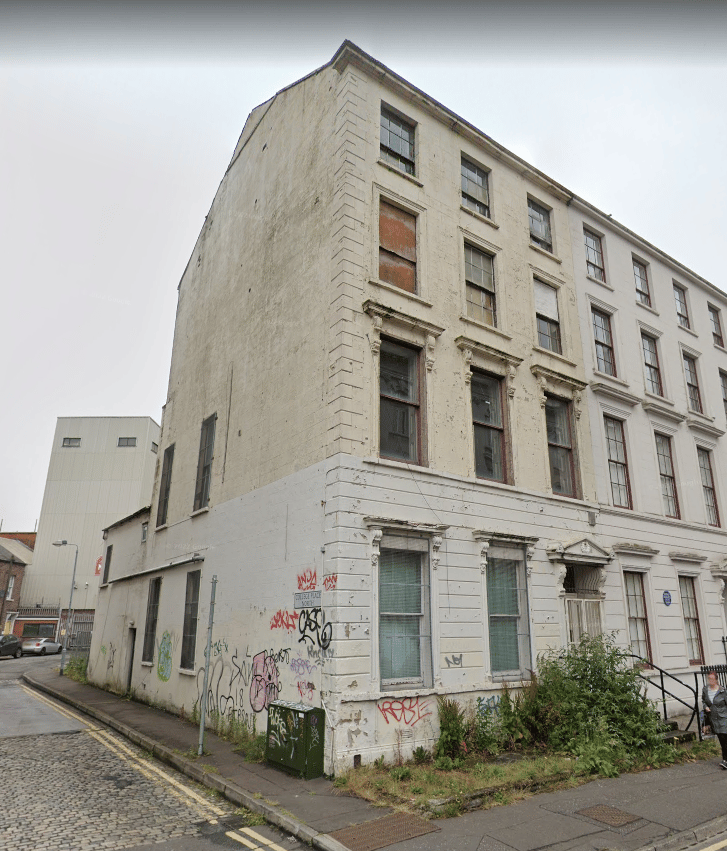
12 College Square North is a Grade B1 listed four storey townhouse that was developed alongside 8-11 College Square North in the 1830s as town housing for wealthy merchants. The terrace is four stories high and was originally brick-faced. The houses were gradually rendered to achieve a fashionable stucco appearance.

The Watson
Updated a year ago
The Watson, constructed between 1898 and 1907, originally functioned as Library House and was designed by William J. Fennell for Robert Watson & Co., a premier furniture manufacturer whose beds featured in royal residences and aboard the Titanic . It’s locally nicknamed the “Smoothing Iron” due to its tapered, wedge-like shape.
